Should You Push or Pull a Dyson Vacuum?
Use both directions: push a Dyson vacuum forward and pull it back in smooth, controlled strokes, unless your model's manual gives different instructions. Let the floor head move freely, and don't force it across a surface where it drags.
On this page (8 sections)
- Should you push or pull a Dyson vacuum?
- How should you make forward and backward Dyson passes?
- Should you change your stroke on carpet or hard floors?
- What should you do if a Dyson is hard to push?
- Can attachments help when the floor head is awkward?
- Is pulling backward safe for your eyes?
- How should you use a vacuum mop instead?
- What is the right push or pull technique for a Dyson?
Push a Dyson vacuum forward and pull it back in smooth strokes, unless your model's manual says otherwise. Keep the floor head flat, move it without forcing it, and pause if it catches or becomes hard to steer.
For ordinary floor cleaning, use both the forward and backward passes to cover the same strip. A steady pace gives you better control than short, fast pushes, especially near furniture or rugs.
Should you push or pull a Dyson vacuum?
Do both: push forward, then pull back in a controlled pass. The floor head travels over the surface in each direction, so you can clean a strip without lifting the vacuum between strokes.
Keep your grip relaxed and guide the machine with your arms. Avoid leaning your body weight into the handle or jerking the vacuum toward you.
The right feel can vary with the model, floor head, and surface. Check your manual for specific instructions, especially if the head has a floor setting or mode that changes how it moves.
How should you make forward and backward Dyson passes?
Move the vacuum in overlapping, even strokes. Push ahead, then draw the head back along the same path or slightly over the edge of the last pass.
On open floor, work in a simple pattern so you can see which strips you've covered. Near a wall or furniture leg, shorten the stroke and guide the head instead of twisting the handle sharply.
If you're using a cordless model with several settings, learn its controls before starting. Our guide to how to use a Dyson V15 Detect explains the basic controls and cleaning setup for that model.
How fast should you move the vacuum?
Move slowly enough to keep the head under control. You don't need to scrub the floor by pushing hard or rushing from one end of the room to the other.
If debris remains after a pass, make another steady pass over that area. Don't repeatedly force the head over a spot that feels rough or snagged.
Should you change your stroke on carpet or hard floors?
Use the floor head and settings recommended for the surface. A change in resistance can be a cue to check the head's position, mode, or the surface beneath it.
Keep the head level as you move forward and back. If it feels stuck on a rug, don't yank the handle; stop, lift or reposition the head as your manual allows, and check for a snag.
On hard floors, steer gently around edges and loose objects. For any surface, stop if the head catches repeatedly, makes an unfamiliar sound, or leaves marks.
What should you do if a Dyson is hard to push?
Stop and check the floor head, settings, and surface before continuing. Turn the vacuum off before inspecting the brush bar or removing debris, and follow your model's instructions.
Look for hair or threads around the brush bar and check that the wheels can turn. Also make sure the head is suitable for the floor and that no rug edge or loose object is caught underneath.
A persistent issue may need model-specific troubleshooting. See why a Dyson vacuum cleaner can be hard to push or the guide to a Dyson V7 becoming difficult to push.
Can attachments help when the floor head is awkward?
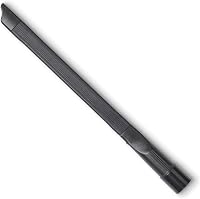
Use a suitable attachment for edges and tight spaces instead of forcing the floor head into them. For narrow gaps, compare extra-long vacuum crevice tools.
Attachments can help reach sofa seams, corners, and narrow gaps, but the connection must fit your vacuum.
Our guide to how to use vacuum cleaner attachments covers choosing and handling tools for detail cleaning. Turn the vacuum off before switching attachments, unless your manual says a different procedure is safe.
For a long, flexible reach into suitable crevices, the FUR-EEL Vacuum Attachment is designed to fit certain round hose sizes; Dyson connections may need a separate adapter.
If you need a Dyson-compatible flexible hose for hard-to-reach gaps, the Fullclean attachment kit names several Dyson handheld models as compatible and excludes upright floor models.
For readers with a compatible Shark vacuum, the LANMU set includes adapters and brush heads for different home and car cleaning tasks.
Don't use an attachment that wobbles or fails to connect securely. Confirm model compatibility and connection fit before using it.
Is pulling backward safe for your eyes?
Keep the vacuum head on the floor and away from your face. Don't use suction near your eyes or pull the hose or attachments toward your face.
For a closer look at the risk and safe handling, read can a vacuum cleaner pull your eye out?. Stop vacuuming if a part is damaged or the machine behaves unexpectedly.
How should you use a vacuum mop instead?
Follow the instructions for the specific vacuum mop, since it may move and operate differently from a Dyson vacuum. Don't assume a wet cleaning head uses the same strokes or settings as a dry floor head.
If you're using a Tineco, see how to use a Tineco vacuum mop for guidance on its cleaning steps. Keep a wet or damp head on the surfaces allowed by that model's manual.
What is the right push or pull technique for a Dyson?
For the question of whether to push or pull a Dyson, the practical rule is to use smooth passes in both directions and let the head travel without force. Check the manual and surface settings if movement feels unusual.
Use attachments for narrow gaps when they fit securely, and inspect the floor head if it catches. If it remains difficult to move after a basic check, stop and use the model-specific troubleshooting guidance before continuing.
Frequently asked questions
Should you push or pull a Dyson vacuum?
Use both directions in smooth strokes: push the floor head forward, then pull it back while keeping it flat on the floor. This lets you cover the area in both passes.
Follow your model's manual, and avoid forcing the head if it catches, sticks, or feels unusually hard to move.
Does a Dyson vacuum clean when you pull it backward?
A backward pass can pick up debris as the floor head moves over the surface, but how it behaves depends on the model and floor head.
Use steady strokes and check the manual for floor-specific advice. If the head lifts, catches, or resists, pause and inspect it rather than pulling harder.
Why is my Dyson vacuum hard to push?
A floor head that is hard to push may be dealing with a surface mismatch, a head setting that doesn't suit the floor, or an obstruction.
Turn the vacuum off before checking the brush bar and wheels, and consult the model's manual. Stop if the head remains stuck or the problem returns.
Should you push a vacuum back and forth quickly?
No. Use measured forward and backward strokes so the head can travel across the floor without being forced.
A slower pass also gives you control around edges and furniture.
If the head is difficult to move, changing speed won't solve the cause, so stop and check the floor head and settings.